
Cherokee Projected Versus Actual Release
A projected release date is an administrative estimate based on the controlling sentence, credit already applied, and legal events known at the time. It is not a pickup time or a promise that a person will walk out of the Cherokee County Detention Center on that day. The actual release date records the later event when one custody episode ended. Even then, the destination may be the community, NCDAC, another jail, or federal custody.
Scheduled versus actual release: Treat the projected date as a changing calculation. Confirm the actual event and destination with the agency that held the person.
A pretrial detainee usually has no sentence-based projected release date. Bond, a court ruling, dismissal, or case disposition controls that path. A sentenced prisoner has a computed term, but the right source depends on custody. NCDAC calculates state prison terms. Cherokee jail staff apply the rules relevant to a local sentence. The Sheriff’s released list records an ended county booking; it does not forecast the date.
Find a Cherokee Projected Release Date
Begin with the present custodian, not the arrest county. A person connected to Cherokee County may be a county detainee, a sentenced local inmate, an NCDAC prisoner, a community supervisee, or a federal detainee. Each status has a different release source. The Cherokee County released inmate search can help distinguish an ended local booking from a current or transferred custody episode.
- Check whether the person is still held at the Cherokee County Detention Center or has a state offender record. Do not treat absence from the live jail roster as release.
- For an active state prisoner, search NCDAC Offender Public Information by offender number when possible. Leading zeros are not required.
- Compare name, birth information, demographics, status, and offender number. Open only the matched detailed record.
- Read the live date label exactly. NCDAC fields can vary with sentence and status, so do not rename a displayed date or assume it means final discharge.
- For a sentenced Cherokee jail inmate, ask the Detention Center for the existing sentence and release calculation. Use the court file to verify the judgment and jail credit.
- For a pretrial booking, follow the bond and court record. There is no earned-time projection before an active sentence exists.
After a state prison release, retry NCDAC with All or Inactive and use the dedicated Inmate Release Search. That release-first tool accepts county, year and month, or last name. It covers NCDAC inmate releases, not every Cherokee County jail discharge.
Cherokee Release Date Credit Rules
North Carolina structured sentencing should not be reduced to a claim that every prisoner serves exactly 85 percent. The familiar estimate arises from the relationship between minimum and maximum terms and limits on earned time. Actual calculations follow the statutes, sentence judgment, jail credit, and NCDAC rules.
For a felony active term, G.S. 15A-1340.13 requires service of the minimum term, subject to jail credit and other authorized rules. Earned time may reduce the maximum term but not below the minimum. G.S. 15A-1340.20 provides the misdemeanor framework. G.S. 15A-1355(c) authorizes qualifying prisoners sentenced under Article 81B to earn credit under DAC rules.
The state statute screenshot documents the felony framework used in a North Carolina release-date calculation. Read the official text of G.S. 15A-1340.13 with the sentence record.
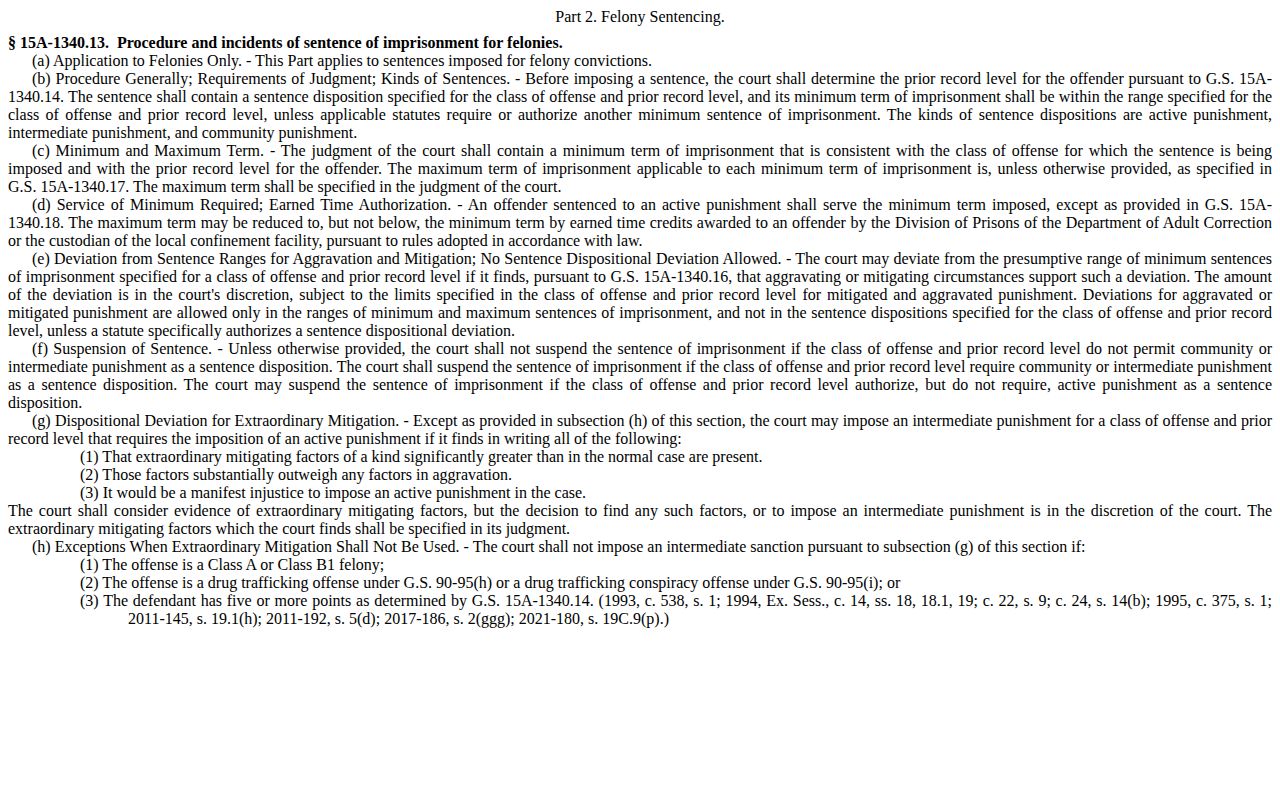
The statute sets boundaries; it does not reveal the credits and legal events posted to one person’s account.
Why Cherokee Release Dates Change
A projected date changes when the facts in the computation change. Some items affect sentence length. Others do not alter the sentence but prevent the expected transition to the community. A date that moves is not necessarily an error.
| Factor | Possible effect | Where to verify |
|---|---|---|
| Jail credit | Credit for qualifying prior custody can alter the remaining term. | Judgment, jail calculation, and NCDAC detail. |
| Earned credit | Authorized credit may reduce a maximum term within statutory limits. | NCDAC or jail sentence account. |
| Discipline | Loss or restoration of credit can move an estimate. | Custodian’s sentence record. |
| Sentence structure | Concurrent or consecutive terms and a corrected judgment can change the controlling date. | Court judgment and corrections record. |
| Detainer or warrant | Another authority may take custody even when one term ends. | Holding agency and new custodian. |
| Appeal or court order | Later legal action may revise the sentence or release authority. | Court case and corrected commitment. |
| Parole action | For eligible legacy cases, a Commission decision can affect release. | Commission material and NCDAC record. |
G.S. 148-10.5 requires NCDAC to work to identify outstanding warrants at intake and before release. That can interrupt an expected transition without erasing the sentence-end calculation.
Confirm a Cherokee Release Date
For a county booking, call the Cherokee County Detention Center at 828-837-2521 and ask whether the person remains held, was released to the community, or was transferred. The office is listed at 577 Regal Street in Murphy with weekday directory hours. Telephone information is a practical check, not a promise that every record will be disclosed by phone. Ask for the existing release or destination record when durable proof is needed.
For a state prisoner, use NCDAC Offender Search, then the Inmate Release Search after the event. A screenshot is not a certified record. NCDAC data questions can be routed through its OPI contact page. A pending custody alert can supplement these checks through the Cherokee County VINELink check, but VINE is not a release order.
Note: Confirm both the end of the old custody and the destination because a transfer can look like release in a roster.
Cherokee Jail Good-Time Calculations
State credit rules can reach a sentenced person who remains in the Cherokee County jail. G.S. 148-13(e) requires DAC earned-time and good-time regulations to be sent to and followed by local jail administrators for sentenced prisoners. The location of confinement therefore does not create a separate Cherokee-only credit system.
The official statute shows why a local calculation still rests on state rules. Review G.S. 148-13 before asking for the jail’s existing calculation.
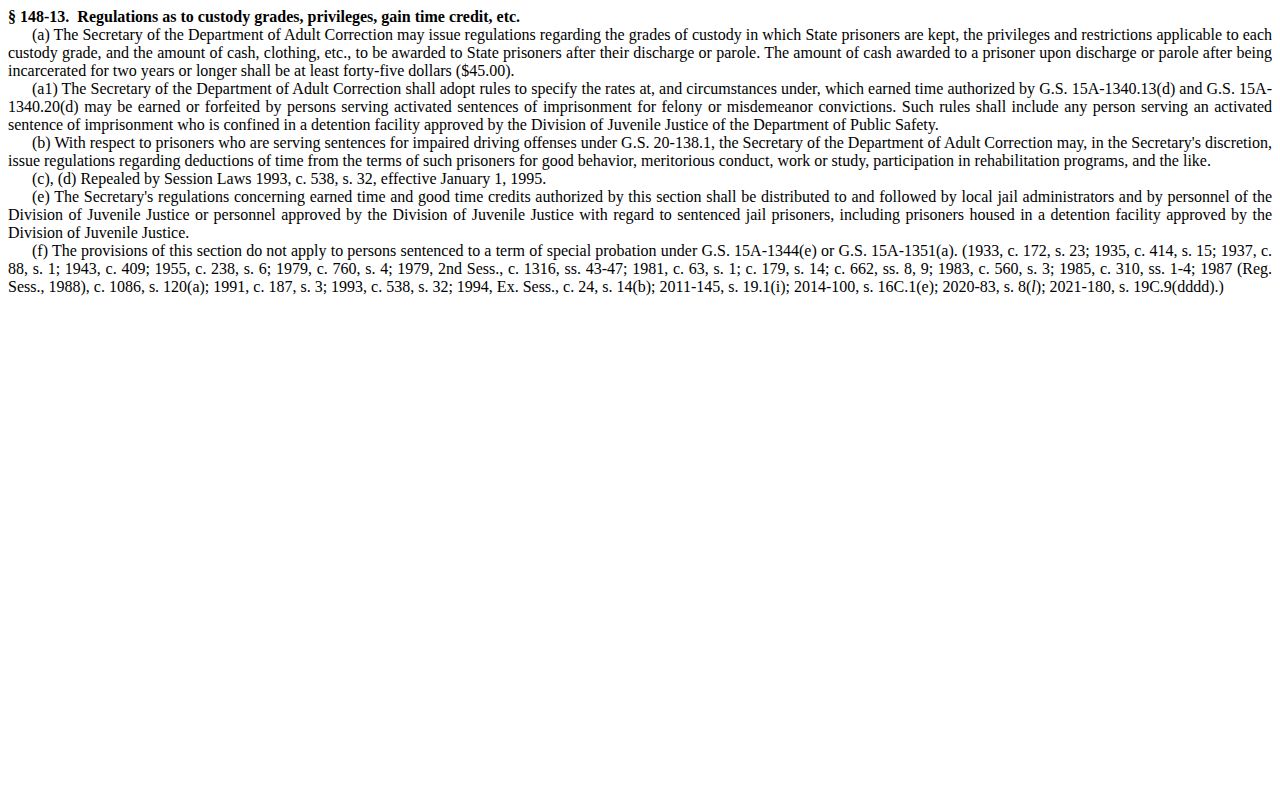
The law supports the rule source, while the inmate’s sentence account supplies the credits actually earned, lost, or restored.
No Cherokee-specific weekend or holiday release rule was verified. Do not move a projected date by assumption. Ask the jail how the controlling sentence was calculated and how the actual discharge will be recorded.
Cherokee Release Sources by Custody
The final source must match the custody type. The Sheriff’s released system records the end of a Cherokee County booking. NCDAC Offender Search and Inmate Release Search cover state correctional cases. Active Probationer/Parolee means the person is in the community under state supervision, not still serving a prison term. Federal sentenced custody belongs in BOP, while immigration detention belongs with ICE. None of these systems controls the others.
If a Cherokee released-booking detail lacks a destination, do not infer freedom from the release date alone. The official Detention Center description confirms transports to Department of Corrections locations and movement of local or federal detainees. Ask for the transfer agency or destination field. Then continue in the new custodian’s record.
Pretrial rule: A detainee awaiting case action has no sentence-based projected date. Follow bond, court orders, and the current custodian instead.
Cherokee NCDAC Release Search Fields
NC DAC Offender Public Information offers more than a name box. The search accepts status, last name, first name, middle name, a sounds-like option, offender number, gender, race, ethnic group, birth date, and age range. Each criterion entered must match. Start with the unique offender number when it is known. If it is not, use a name plus one reliable fact, then narrow only when too many results remain.
Status selection also changes the question. Active Inmate means the person is presently serving a sentence in an NCDAC prison. Active Probationer/Parolee means the person is in the community under NCDAC supervision. Inactive covers someone formerly active as an inmate or supervisee who is not active now. It is a useful historical filter, but it does not state the custody-end reason or isolate a recent state prison release.
Read the detail in context. Incarceration, sentence, supervision, and date fields may each describe a different part of the correctional history. A projected release-related label shown for an active inmate is tied to that status and sentence structure. Once the release occurs, use the dedicated NCDAC Inmate Release Search as a second path. Select Cherokee only when researching NCDAC’s release-county field. That county field need not be the arrest county or the source of a Cherokee jail booking.
Note: An offender number is the best match key because names, partial dates, and demographic fields can identify more than one person.
After a Cherokee Prison Release
Reaching a sentence-based date does not always end the state correctional relationship. A qualifying structured-sentencing term may lead from prison into post-release supervision. The NCDAC status can then change from Active Inmate to Active Probationer/Parolee. That is release from confinement, not full discharge from the sentence or supervision duty. The supervising office must be confirmed through Community Supervision because it can differ from the county of conviction.
Legacy parole follows a different route. The North Carolina Post-Release Supervision and Parole Commission handles sentences and categories that remain parole-eligible. It does not publish a conventional calendar of formal personal offender hearings. Its monthly Discretionary Parole Reviews are the correct public review channel. Do not insert a parole date into a Cherokee County projection unless the governing sentence and official Commission or NCDAC record support it.
State discharge assistance is another narrow rule. For state prisoners incarcerated for two or more years, G.S. 148-13(a) requires at least $45 in cash assistance at discharge or parole and permits rules on clothing and cash. That provision applies to the state prison setting. It is not a promise of gate money from the Cherokee County Detention Center and does not change the projected date itself.