
Cherokee Parole and Probation Compared
Parole, probation, and post-release supervision all allow a person to live outside a prison while meeting set terms. They are not interchangeable. Probation may be ordered without a state prison term. Post-release supervision follows qualifying North Carolina structured-sentencing prison terms. Legacy discretionary parole chiefly concerns sentences under earlier law and other categories made eligible by statute. A release from the Cherokee County Detention Center on bond, after time served, or by another jail discharge does not become parole merely because the person has left a cell.
| Supervision type | How it begins | Best public check |
|---|---|---|
| Probation | A court orders community supervision, which may occur without a prison term. | NCDAC Offender Search under Active Probationer/Parolee, then the detailed record and court file. |
| Post-release supervision | It follows a qualifying structured-sentencing term served in state prison. | NCDAC offender detail and Community Supervision office confirmation. |
| Parole | It applies only when the sentence and governing law permit discretionary parole. | NCDAC status, the Commission process, and its monthly review publications. |
| No active supervision | The supervision term has ended or no supervision was imposed. | An Inactive NCDAC result may support history, but the detail and court record must establish why. |
The NCDAC search help defines Active Probationer/Parolee as a person currently present in the community under NCDAC supervision. “Inactive” is broader. It means the person was once active as an inmate or supervisee and is not active now. It does not, by itself, prove a date or reason for discharge.
- Discharge
- The formal end of a custody or supervision obligation shown by the responsible agency.
- Absconder
- A person reported as failing to remain available to the supervising agency.
- Revocation
- A legal action that can end community supervision and may lead to confinement.
- Detainer
- A request or hold from another authority that can affect where a person goes next.
Verify Cherokee Post-Release Supervision
The public starting point is NC DAC Offender Public Information. Use an offender number when possible because it is the most exact identifier. A name search can be narrowed with birth date, age, gender, race, or ethnic group. All entered criteria must match, so an incorrect detail may suppress the right record. Search “All” if a status-only search yields no match.
- Choose Active Probationer/Parolee in the NCDAC status field. Retry with All if the first search fails.
- Enter the offender number without leading zeros when it is known. Otherwise use a full or partial name and only reliable identifiers.
- Compare the offender number, birth information, and other identifiers before opening a result. A shared name is not enough.
- Read the detailed incarceration and supervision sections. Note the supervision type and office information actually displayed.
- Confirm the current office through NCDAC Community Supervision. The reporting county can change and need not match the county of conviction.
- Use the court case record when the question concerns an order, violation proceeding, or termination rather than the current corrections status.
A Cherokee County Detention Center released record answers a different question. Its entry proves that a county booking ended, not that NCDAC supervision began. If the jail record suggests transfer to state custody, follow that new episode in NCDAC. The broader Cherokee County released inmate search paths explain how the jail, court, and state records fit together.
Note: A person can be outside prison and still remain active in the state correctional system as a supervisee.
Cherokee Supervision Office Confirmation
NCDAC Community Supervision manages probation, parole, and post-release supervision across North Carolina. The research did not establish a stable public street address, direct telephone number, or public hours for a Cherokee-specific reporting office. It would be unsafe to invent them. The statewide directory route is more durable because a case may be reassigned or supervised outside Cherokee County.
North Carolina Department of Adult Correction
Community Supervision
Current office route: Community Supervision directory
Record status: NCDAC Offender Search
Use the office shown on the live offender detail, then verify it through the directory. Do not assume that a Cherokee conviction means the person reports in Cherokee County. A move, transfer of supervision, or specialized caseload can change the office. For an authenticated correctional record, use the appropriate NCDAC records channel rather than relying on a saved screen.
Cherokee Probation Absconder Records
NCDAC maintains a separate Absconded Probationer Search. It accepts a last name and county of supervision. Use the county of supervision, not just the county of conviction or arrest. An absconder listing means the person is reported as failing to remain available to supervision. It does not establish that the person has been arrested, that supervision was revoked, or that a new prison admission has occurred.
The official absconder screen helps show the narrow scope of this lookup. It should be paired with the current offender detail and the court file when a later action matters. Open the NCDAC absconder search to compare its fields.
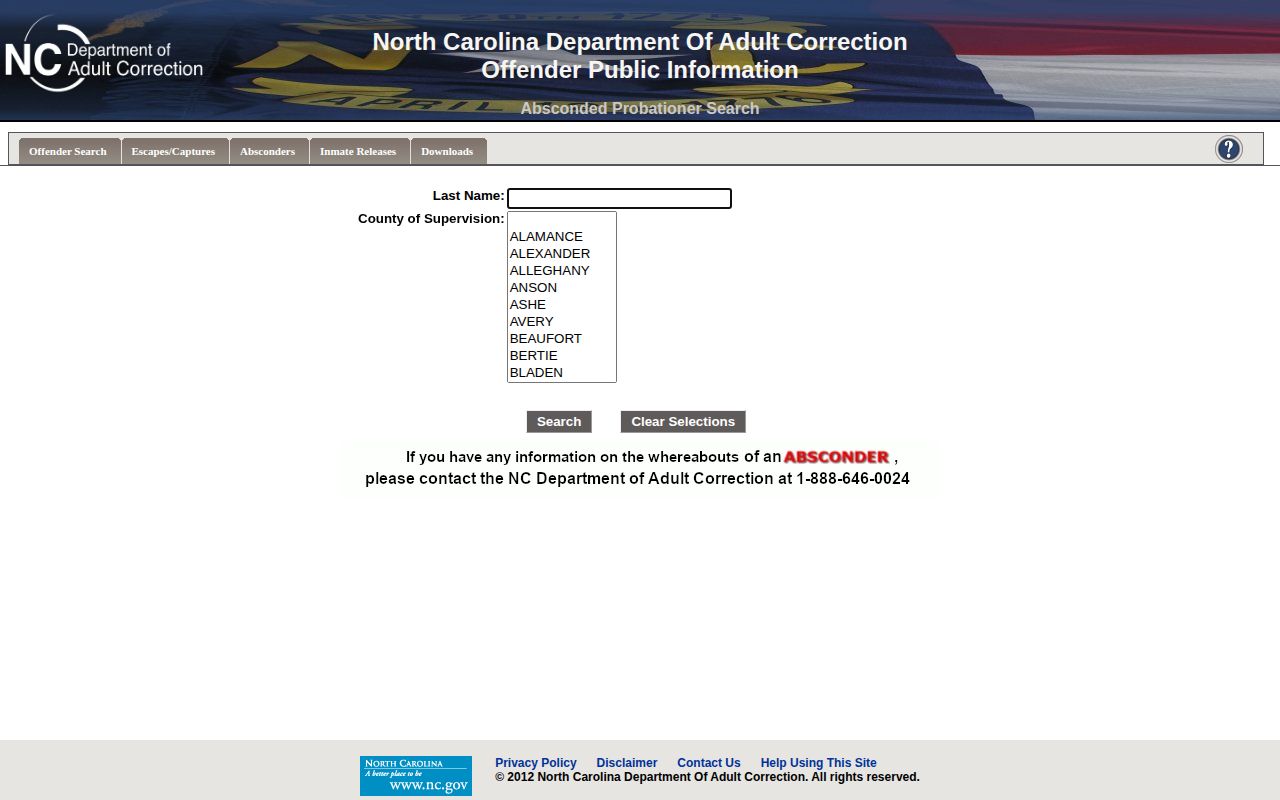
The screen searches a supervision status; it is not a warrant return, jail roster, or proof of a court ruling.
Important: Absconding is a supervision status. Confirm any warrant, arrest, revocation, or return to custody through the agency and court record that created that event.
Cherokee Parole Review Records
The North Carolina Post-Release Supervision and Parole Commission handles post-release matters and legacy discretionary-parole cases. North Carolina does not provide a conventional public calendar of formal, in-person offender hearings. The Commission states that it does not hold formal hearings or meet personally with offenders. A claim that a named Cherokee County person has a public hearing date should not be made from another state’s procedure.
The correct public substitute is the Commission’s monthly Discretionary Parole Reviews. Those publications record the cases considered and the results in the terms the Commission actually uses. Eligibility depends on the offense date, sentence type, minimum term, credits, and special offense rules. G.S. 15A-1371 governs parole eligibility and release for sentences to which parole law applies, but it cannot be reduced to one fraction for every person.
Note: Structured-sentencing release usually involves post-release supervision, while parole remains tied to sentences and categories made parole-eligible by law.
Cherokee Supervision and VINE Alerts
North Carolina VINE is a custody-notification tool, not a probation office directory. It can help track a person who remains in a participating jail or prison and can send notice of a release, transfer, or custody change. It does not certify the start or end of probation. A VINE event should be compared with the NCDAC supervision record and, when needed, the order in the court case.
Search North Carolina VINELink by name or available identifier, select the correct custodial agency, and register only after matching the person. Cherokee County jail and NCDAC are separate data sources even when both appear through one portal. If a registration follows a transfer, update it because the agency or offender identifier may change.
Correcting Cherokee Release Records
A wrong release field can distort how a later supervision record is read. For an error in a Cherokee County Sheriff release record, identify the exact booking and disputed field. Add the court or release document that supports the correction, then ask the Sheriff record custodian to correct the existing record. The request should not ask the Sheriff to create a new account of events.
An expunged record that persists in a covered private compiler follows a different path. G.S. 15A-152 supplies a deletion-notice and personal-verification process when its conditions apply. An expunction affects public visibility; it does not convert a probation record into parole or establish that NCDAC supervision has ended. Confirm discharge in the agency record responsible for supervision.
How Cherokee Supervision Ends
Community supervision ends through the legal and administrative process that governs the sentence. Completion, discharge, termination, or revocation are not synonyms. A later Inactive NCDAC status is useful historical evidence, but the detailed record and court orders must be read before assigning a reason. If the person was first released from the Cherokee County Detention Center, that county release record proves only the close of that booking.
For a state correctional case, preserve the offender number and review the detailed incarceration and supervision entries. Ask NCDAC for an authenticated record if formal proof is needed. For a court-ordered change, use North Carolina Portal or the Cherokee County Clerk record. When a future prison release date is also at issue, the Cherokee County projected release date route explains how credits and legal events alter the estimate.
One final check matters: a person may finish one form of supervision while another custody matter remains. A federal, immigration, county, or state record does not control the others. Match each status to the agency that created it.