
Understanding Cherokee County Releases
A release entry marks the end of one custody episode. It does not always mean the person walked out free of all custody. At the Cherokee County Detention Center, a booking can end through bond, completion of a jail term, a court order, dismissal, or another lawful discharge. It can also end when transport officers move the person to the North Carolina Department of Adult Correction, another jail, or federal custody. The destination and the related court record distinguish community release from continued custody elsewhere.
The official Sheriff database keeps a released mode separate from its current-custody view. That distinction matters. A person who no longer appears under “In Custody” may have a released-booking row, but absence from the live roster alone does not establish the reason for departure. The released row, individual booking detail, court docket, and receiving-agency record provide the better chain of proof. Each source answers a narrower question, so compare them instead of treating one screen as the whole record.
A Cherokee County booking can close because of transfer. Confirm the destination before describing the event as release to the community.
Cherokee County Release Types
Release language describes why local custody ended, not necessarily what happened to the criminal case. Bond permits a person to leave jail while the charge continues. “Time served” generally means credited custody satisfies the ordered jail term. A dismissal concerns the charge, while a transfer ends Cherokee County custody and begins or continues custody under another authority. Parole, probation, and post-release supervision describe community control, but they arise under different laws and records.
| Release path | What it means | Next official check |
|---|---|---|
| Bond or court order | The jail stay ends while the case may remain open. | Sheriff released detail and North Carolina Portal |
| Time served | The ordered local custody term has ended. | Release timestamp, judgment, and jail-credit record |
| Transfer | Cherokee custody ends, but another custodian receives the person. | NCDAC, another jail, BOP, USMS, or ICE |
| State discharge | An NCDAC custody episode ends. | NCDAC Offender Search and Inmate Release Search |
| Supervised release | The person lives in the community under stated conditions. | NCDAC status and Community Supervision |
Cherokee County Release Record Fields
The official Cherokee released-inmate grid publishes the core fields needed to identify a completed jail booking. It is stronger evidence than a name disappearing from the current roster because it supplies both admission and release information. Open the row detail when available, and treat each row as a distinct episode. One person may have more than one booking.
| Field | What it establishes |
|---|---|
| Full Name | The name attached to that released booking |
| Age, Race, Sex | Identity checks that help separate similar names |
| Admit Date | Start of the displayed custody episode |
| Release Date | End of that Cherokee County booking |
| Time In Jail | The system’s elapsed calculation, not automatically the sentence length |
| Detail link | Additional booking and charge information |
The county’s released fields are visible in this official released-list capture.
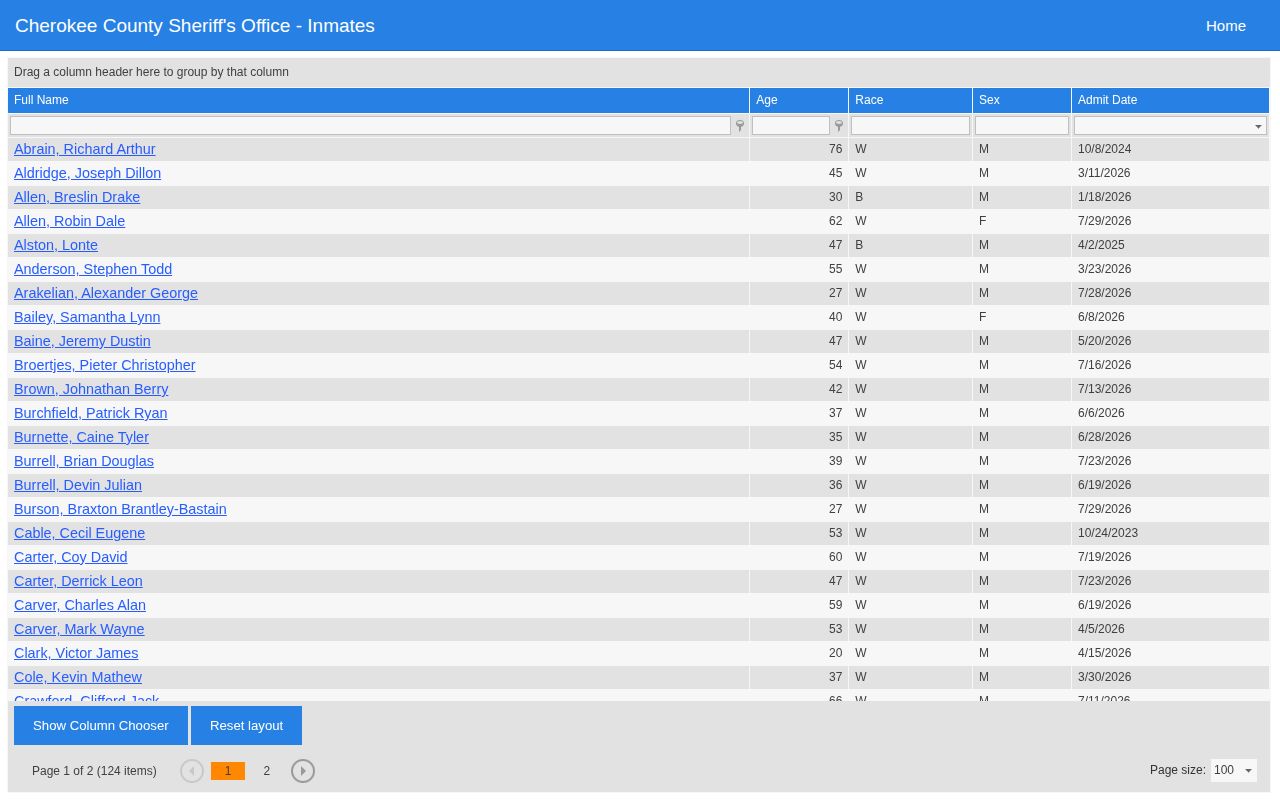
The grid lets a reader compare admission and release dates before opening the booking detail.
Request Cherokee County Release Records
When the public grid lacks a destination, booking number, photograph, or other needed existing record, direct the request to the Cherokee County Sheriff’s Office. No dedicated online form, county booking-photo fee, fixed response time, or release-record retention schedule was verified. G.S. 132-6 calls for public records to be available at reasonable times and produced as promptly as possible. G.S. 132-6.2 permits actual-cost copying and certain documented special-service charges.
- Identify the person by full name and date of birth, if known.
- Give the booking or admit date and booking number when available.
- Name the exact existing record, such as the released booking, release transaction, destination, or booking photograph.
- Ask the custodian to state any copy cost before work begins.
- Compare the response with the court or receiving-agency record.
577 Regal Street
Murphy, NC 28906
Mail: 75 Peachtree Street, Murphy, NC 28906
Phone: 828-837-2589
Fax: 828-837-6590
A request for an electronic copy can reduce copying work, but the custodian controls the format in which an existing record is kept and can be supplied. North Carolina’s public-record law is purpose-neutral. The office may separate confidential material from the public portion, and it is not required to create a new explanation, calculate an answer, or combine records that do not already exist.
G.S. 132-1.4 makes specified arrest facts public but treats criminal-investigation records, including photographs, differently. A photo request remains subject to the custodian’s legal decision. If it is withheld, ask for the reason and request the segregable public arrest information.
Cherokee Release Records After Expunction
An expunction changes public visibility. It does not erase the historical fact that custody occurred. Under G.S. 15A-146, some dismissed or not-guilty matters may qualify for automatic expunction 180 to 210 days after final disposition. G.S. 15A-151 addresses confidential retention of certain expunged court files, while G.S. 15A-152 supplies procedures tied to deletion notices and personal verification in covered circumstances.
A person seeking proof of their own expunction should use the Clerk or Administrative Office of the Courts confirmation process. Qualifying nonviolent convictions follow the separate rules in G.S. 15A-145.5. No reviewed source established a universal Cherokee County deletion schedule.
Correct Cherokee Release Record Errors
For an error in a Sheriff release record, identify the exact booking and disputed field. Attach the court order, release document, or other official record that shows the correct fact, then ask the record custodian to amend the existing entry. The request should not ask the Sheriff to create a new account of events. It should state what field is wrong and why the attached source resolves it.
An expunged record persisting in a covered private compiler follows a different route. G.S. 15A-152 supplies a deletion-notice and personal-verification path when its conditions apply. That process does not let a private site alter the Sheriff, court, or NCDAC source record. Use the custodian responsible for the disputed system.
Find Cherokee County Released Inmates
The correct search order follows the custodian. Start with Cherokee County when the person was held locally. Shift to NCDAC only when state correctional custody or supervision is involved. Court, federal, and immigration systems supplement those records, but none acts as a universal released-person database.
- Use the Sheriff’s released search by name, charge, or a chosen number of days.
- Open the released grid row and compare at least two identifiers, such as age and admit date.
- Check the current-custody side only to learn whether Cherokee still holds the person.
- Use NCDAC All or Inactive search when transfer, state prison, or supervision is plausible.
- Check Portal for the case outcome, then request the record if the public screens leave the destination unclear.
The 24-Hour Release List and 72-Hour Release List explain the one-day and three-day settings. Both settings run through the same official county form.
NCDAC Cherokee Release Lookup
The NCDAC Offender Search covers state correctional records, not every Cherokee jail booking. Select “All” or “Inactive” when looking for a person whose state custody ended. A unique offender number is the safest key. Name, gender, race, date of birth, and age range can narrow the search, but a name-only match is not enough.
| Field or choice | Use |
|---|---|
| Status | All, Active Inmate, Active Probationer/Parolee, or Inactive |
| Offender number | Best key for a known state record |
| Name | Supports partial matching but needs identity checks |
| Birth and demographic fields | Reduce false matches |
| Detailed record | Shows status, sentence, incarceration, and supervision data where published |
The statewide form’s status choices appear in this official NCDAC search capture.
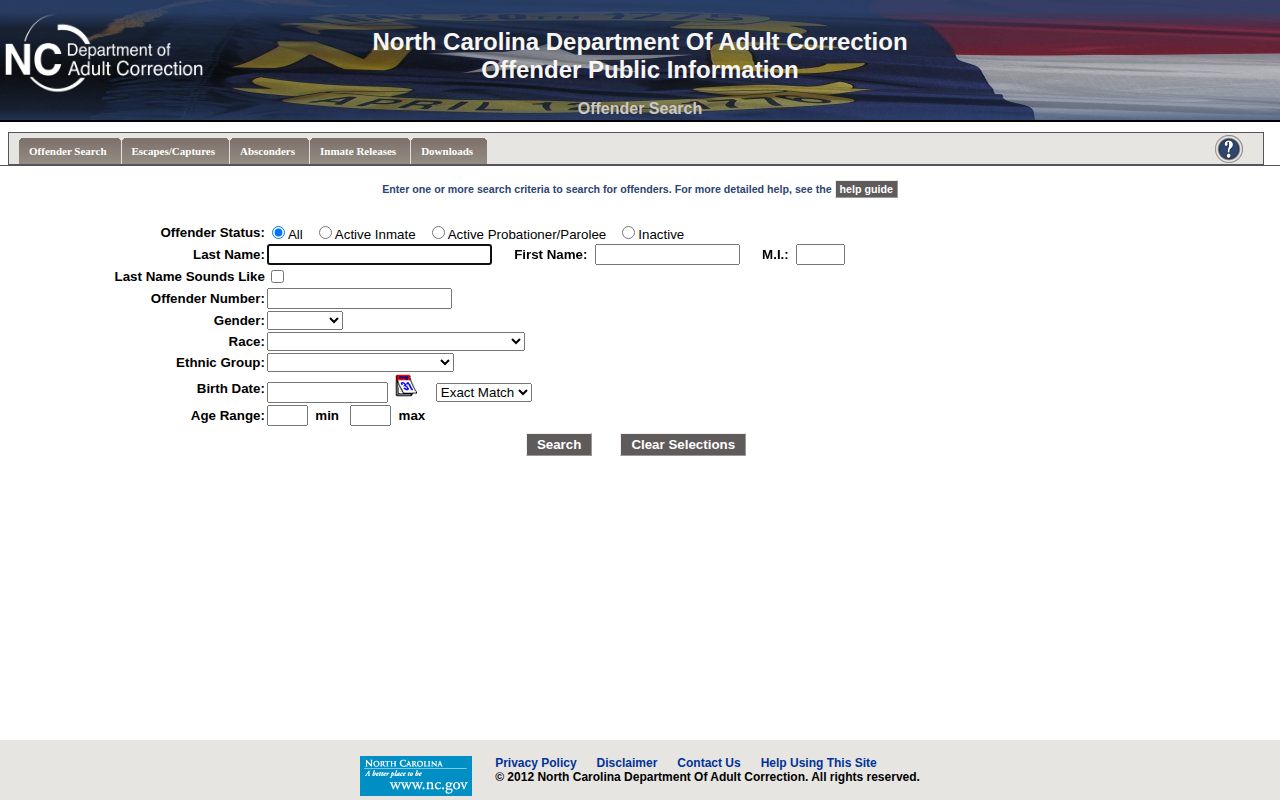
The filters separate inactive state records from people still imprisoned or under active supervision.
The separate NCDAC Inmate Release Search accepts county, month, and year or a name. A county choice does not make it a duplicate of the Cherokee jail list. For an active person, a displayed tentative date remains prospective. For someone already released, use the incarceration or release history as the actual state custody endpoint.
Cherokee County Recent Release Search
The local form’s “Over the last number of days” field creates the recent view. Enter 1 for the prior 24-hour window or 3 for 72 hours. The county does not publish a stable result URL for either setting or promise a real-time update cycle. The full grid contains older entries, but that history is not a formal retention guarantee.
The service uses plain HTTP on port 8080. A browser that forces HTTPS may fail to load it. Use the exact county link, and call the Detention Center at 828-837-2521 if the interface is unavailable. No official Cherokee County, North Carolina Sheriff mobile app or app-only release feed was verified.
Cherokee Post-Release Supervision Records
“Active Probationer/Parolee” is the strongest statewide public indication that a person lives in the community under NCDAC supervision. Probation is a court-ordered sentence. Post-release supervision follows many structured-sentencing prison terms. Parole applies mainly to legally eligible cases governed by parole law. These terms are not interchangeable.
- Probation
- Community supervision imposed by a court.
- Post-release supervision
- A supervised period after a qualifying state prison term.
- Parole
- Conditional release under the law applicable to eligible sentences.
- Discharge
- The recorded end of a custody or supervision obligation.
Use Parole & Probation for Community Supervision, absconder records, and the Commission’s monthly discretionary reviews. An absconder is a person alleged to have stopped reporting or left supervision without authorization.
Cherokee Release Alerts and Registries
North Carolina VINE supplies custody status and notifications from participating agencies. Search for the person, confirm the agency and identifiers, open the right record, and then register for an offered phone, text, or email alert. VINE is a notification system. The Sheriff or NCDAC holds the underlying release record, and a missing VINE result proves nothing about a past custody episode.
The North Carolina Sex Offender and Public Protection Registry is a separate channel for people with a statutory registration duty. It is not a general archive of Cherokee County released inmates.
Where Cherokee Release Records Live
Match each search to the custody type and event. A current roster is not a historical release archive.
| Question | Correct source | What it does not prove |
|---|---|---|
| Is Cherokee holding the person now? | Current-custody interface | Why a prior booking ended |
| When did the local booking end? | Sheriff released grid | Final court outcome |
| Did state custody end? | NCDAC searches | A county release by itself |
| What happened in court? | Portal and Clerk | The jail exit transaction |
| Did federal custody change? | BOP locator | Release from another authority |
Cherokee Bond Release Records
A bond release ends the immediate jail stay, but the criminal case continues. The Sheriff’s release date documents the end of local custody. The bond order, later hearings, and final disposition belong to the court record. Cherokee County’s local rules and forms page publishes the local bail and pretrial-release policy. No county-operated pretrial-services program or simple public dollar bond schedule was confirmed.
The North Carolina Portal is the online case-search route. The Sheriff entry and Portal docket should be read together because they describe different events. A later failure to appear or new order can create another booking with another number. Magistrates can be reached at 828-835-7755 for the court function they serve, but the Detention Center remains the source for the jail’s release transaction.
Cherokee Release and Court Outcomes
Sheriff data answers when the Cherokee booking ended. Portal and the Clerk answer how the case proceeded. Absence from “In Custody” proves neither the release reason nor the final court outcome. A time-served judgment can occur near the release, yet the jail timestamp and judgment remain separate records.
The Cherokee County Courthouse is at 75 Peachtree Street in Murphy. Its weekday public hours are split: 8 a.m. to 12:30 p.m., then 1:30 to 5 p.m. The midday closure is a practical detail for anyone planning an in-person document request. The Clerk’s number is 828-835-7740.
The official location and hours appear in this courthouse page capture.
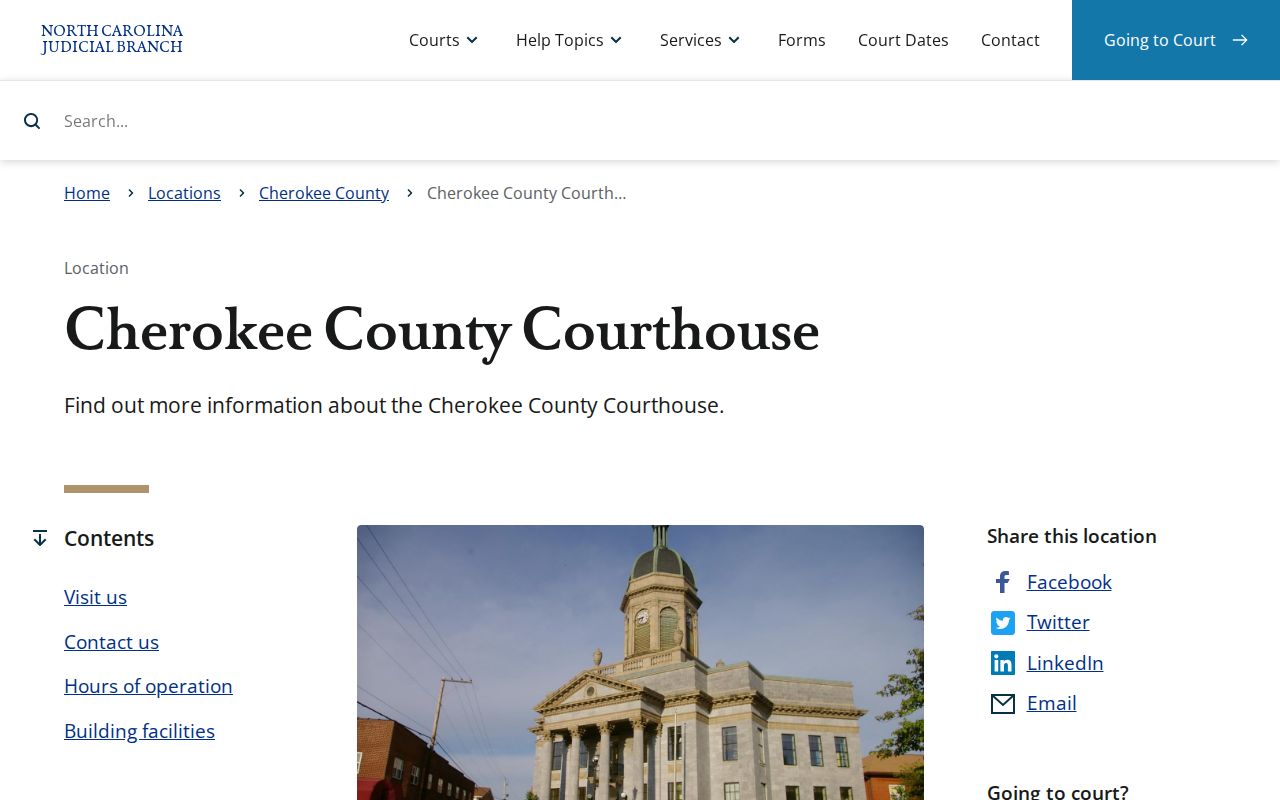
The split schedule helps avoid arriving during the courthouse’s published midday closure.
Property After Cherokee County Release
Cherokee County publishes an unusually specific after-release rule. A person released to the community has seven days to collect an undelivered commissary order before it is donated. The Inmate Finance page treats transferred people differently. That distinction reinforces why the destination must be confirmed before calling a closed booking a community release.
Money releases are handled at the main finance office Monday through Friday from 9 a.m. to 4 p.m. The receiving person must show valid identification, and payment is issued by check. The Inmate Trust Account page explains the county’s treatment of balances and property. These steps help retrieve funds and items, but they do not state the legal release reason.
Getting Home After Cherokee Release
Cherokee County does not publish one universal release hour, exit door, weekend schedule, or family waiting area. Cherokee County Transit offers advance-scheduled, capacity-dependent service and daily trips around Murphy, Andrews, Marble, and Peachtree. Its office is at 40 Peachtree Street, Suite 110 in Murphy. The number is 828-837-1789, and office hours are weekdays from 8 a.m. to 5 p.m.
The county does not promise a jail pickup. Transit is only a possible prearranged option. Confirm release details with the Detention Center and plan the ride around information supplied by the facility rather than an assumed fixed hour.
Cherokee Federal Release Checks
The BOP Inmate Locator is the public starting point for sentenced federal custody, generally for records from 1982 forward. “Released” or “Not in BOP Custody” concerns BOP custody only. A federal pretrial detainee transported through Cherokee County may require a federal court or U.S. Marshals Service check because the person may never have entered BOP custody.
The ICE Online Detainee Locator System covers current or recently released immigration detention. A result may reflect release, transfer, or removal. Follow up through the appropriate ICE field office when the destination is unclear. No dedicated BOP prison or ICE detention center in Cherokee County was confirmed.
Cherokee Detention Records Changed
The current Cherokee County Detention Center opened in 2008. It replaced a 1922 jail designed for 43 people and expanded capacity to nearly 150 beds with specialized dorms and work-release space. Older directory descriptions may therefore identify the wrong building or capacity. The same official facility page confirms local and federal transports and movement to Department of Corrections locations.
Cherokee Historical Jail Statistics
The Sheriff’s historical statistics report average daily populations of 68 in 2010, 124 in 2011, 81 in 2012, 112 in 2013, and 106 in 2014. These are historic population figures, not release counts or current conditions. They document older detention workload only and should never be presented as the number of Cherokee County released inmates.
Cherokee County Release Facility
Only one physical detention or correctional facility in Cherokee County was confirmed through official sources. The Cherokee County Detention Center holds county detainees and performs transports. No separate Murphy or Andrews municipal jail, NCDAC prison, BOP institution, or dedicated ICE center in the county was verified. Its released search is the first local check, while a receiving agency controls the record after transfer.